

Routal blog

Top list of route optimizers 2026
If your delivery operative lives in Survival mode (last-minute changes, impatient customers, new drivers every week and planners putting out fires), choose a route optimizer It's not about “putting directions on a map”. It Goes From Reduce stress, Standardize processes And Keep the service stable, even when the day turns twisted.
And here comes the uncomfortable part: In many companies, the “route optimizer” is still a person. The typical essential figure: “Leave it to X, who knows the city better than Google”. Spoiler: it's usually expensive.
In this article I leave you a Comparative list of optimizers 2026, highlighting Routal And comparing it to Circuit, Route4Me, Onfleet... and with the most common (and dangerous) alternative: manual planning.
The real problem with the cast: low training, high turnover and a very stressful environment
In the last mile, chaos is no exception: it's context.
- Drivers with Little Training (or Too Little Time to Train): you need the tool to be intuitive from minute 1.
- High turnover: if your operations depend on “key people”, every loss breaks your service.
- Operational stress: incidents, absences, peaks in demand, time windows... everything requires reacting quickly without losing control.
- Invisible cost: “Where's my order?” calls, redeliveries, extra kilometers and planners redoing routes by hand.
A good route optimizer doesn't just calculate the “shortest” order. It also helps you to Operate with Rules, monitor And Communicate ETAs with reliability.
What a route optimizer should have in 2026
If you're comparing tools, these are the capabilities that (today) make the difference:
- Real usability: let the planner plan quickly and the driver doesn't get lost (or fight with the app).
- Complex restrictions: time windows, capacity, zones, priorities, service times, skills, etc.
- Reoptimization and incident management: last-minute changes without blowing up the day.
- Real-time monitoring and operational visibility.
- Communication with the customer: tracking and ETAs (fewer calls, more trust).
- Constant support: when something happens, you need a response (not a “queued ticket”).
Comparison: Routal vs manual vs Circuit vs Route4Me vs Onfleet
1) Routal: the simplest, most efficient solution with the best support
Routal is designed to make the operation work Even if the equipment changes And the day comes crooked: quick planning, powerful restrictions, monitoring and communication, without turning the tool into a master's degree. Routal is positioned as a complete platform for Optimize and Monitor Last-mile operations and Communicate the estimated time of arrival In a precise way.
Where it shines especially
- Usability: plan routes in a very short time (without “setting up an airplane”).
- Complex operations with restrictions: time windows, capacities, zones, priorities, service times... (without going crazy).
- Support and support: a live, operation-oriented help center (planner, constraints, drivers, customers, integrations).
- Comprehensive platform: from planning to delivery and customer experience (and with integration capacity).
Impact when there is little training and high turnover
With Routal, you reduce dependence on the “hero employee”: anyone on the team can plan and execute according to rules, not memory.
Positioning data (if you want to use it in marketing): Routal reports savings of “+30% gas” and “90% of time” in planning/management, in addition to monitoring and communicating ETA. Use it as a claim with context (depends on the use case).
2) Manual optimizer: “the person who knows everything”... but is not as good as you think
Manual planning usually seems cheap because it already “exists”: someone with experience, an Excel, WhatsApp and Google Maps. But in 2026, that system has serious side effects:
What usually happens
- It Doesn't Scale: the more stops, the more chaos.
- It is not reproducible: If that person is missing, drop the service.
- It doesn't really optimize: Intuition doesn't calculate all possible combinations (let alone with restrictions).
- It Eats Your Margin: extra kilometers + redeliveries + time planner redoing routes.
- It increases stress: because everything depends on putting out fires manually.
If your company lives with turnover, peaks in demand or strict time windows, the manual ceases to be “artisanal” and becomes An Operational Risk.
3) Circuit (Circuit/Spoke): more basic at the functional level, great user experience
Circuit usually stands out for Simple user experience, especially for less complex scenarios or small teams. There is recent content that describes it as a tool designed to simplify planning, with a clear and easy interface for drivers.
When It Fits
- If you prioritize Facility and you don't need too much operational complexity.
- If your operation is more “linear” (fewer restrictions, fewer exceptions).
Where it may fall short
- When You Need Advanced Rules, complex restrictions or a lot of operational flexibility.
- When you go from “planning” to Manage Operation in Real Time with incidents.
4) Route4Me: very complex, many add-ons, high price
Route4Me is known for being powerful and with a large ecosystem, but its own structure of plans and packages may involve more complexity of purchase and configuration (model with different options/packages).
When It Fits
- Organizations that want a highly configurable “lego” and are willing to invest time in implementation and learning.
Where it slows down in stressful environments
- In operations with Little Training Or High turnover, complexity translates into friction.
- If every need is solved with an add-on, it's easy for cost and maintenance to grow.
5) Onfleet: specialized in on-demand (dispatch, tracking and POD)
Onfleet is clearly positioned as a last-mile management platform, with real-time tracking, customer notifications and proof of delivery (POD), in addition to auto-dispatch/optimization oriented to dynamic scenarios.
When It Fits
- If your operation is very On-Demand (orders come in all the time and you assign the “best” driver in real time).
- If you prioritize visibility, POD, and communications.
Where it may not be your best option
- If your main challenge is Complex planning (lots of restrictions and fine rules) and you're looking for a balance between power and ease for the team.
Quick summary (in case you're deciding this week)
- Do you want the best balance between usability + power + support for operating with stress and rotation? → Routal.
- Are you looking for something simple and with good UX for less complex cases and little support? → Circuit.
- Do you need a very “enterprise”, configurable system, with more complexity and possible add-ons? → Route4Me.
- Are your operations on demand and do you value dynamic dispatch? → Onfleet.
- Are you still doing manual planning? → eye: this is usually the biggest bottleneck in 2026.
Why Routal usually wins in companies with complex operations (without killing the team)
When there are low training, high turnover and stress, what you need is not “a tool with a thousand buttons”, but one that:
- Sea Easy to Adopt,
- Holder Real Restrictions,
- I'll Give You Real Time Control,
- And have Constant Support when the day gets complicated.
That's exactly where Routal usually stands out.
If you are comparing a route optimizer For 2026, the key question is:
Do you want a tool that your team will actually use, even when people change and plans change?
Routal is designed for that. If you want to know the tool, you can request a demonstration without obligation here.
%20(30).webp)

Today we live in a new era of transformation in human history. We are impacted by the digital revolution that is redefining many aspects of modern life around the world.
And Artificial Intelligence is playing a fundamental role in several fields. From transportation and logistics to healthcare, customer care and home maintenance.
Evolution of Artificial Intelligence and its benefits
From sci-fi movies to real life, AI has come out of research labs to become an environmental part of our personal lives:
Nearly 60% of organizations use AI in one form or another and it's predicted to affect every segment of our lives by the end of 2025, with notable implications for industries.
For example, by analyzing patient data, AI can make predictive diagnoses in the field of healthcare; what's more, by analyzing student data, it provides teachers with information about their performance and advice on how to improve them and improve studies, to name just a few.
And then you can see how AI evolved from being just a term coined in 1956 to focusing on specific problems in 2016.

Therefore, if there is a conclusion to be drawn, it will be that AI will greatly benefit all industries; it will make life easier in certain areas where data analysis is necessary. Already today, AI is closely connected to customers, to the functions of companies, to online and offline retail, and is making its way into the field of logistics that is beginning its journey to become an industry driven by AI, as Routal has demonstrated in its different products. That's why there's every reason to believe that now is the best time for the logistics industry to adopt AI:
-First, technological advances in various fields such as machine learning, big data and connectivity have improved performance, accessibility and The costs of AI are more favorable than ever.
-Second, the network-based nature of the industry provides a natural framework and a good opportunity to implement and scale AI. -And last but not least, let's not ignore that all companies are moving towards the use of AI, so not adopting it will put your company at risk of long-term obsolescence.
Artificial intelligence and logistics
In a deeper approach, logistics companies are particularly positioned to benefit from the application of AI in almost every aspect of the supply chain thanks to the large volume of data that is generated daily and that allows AI to exploit it to provide the company with detailed information. In addition, logistics companies rely on networks and routes that must work harmoniously between large volumes, low margins and urgent deadlines; AI offers logistics companies the ability to optimize the composition of the network to degrees of efficiency that cannot be achieved with human thought alone. It also helps the logistics industry to redefine current practices, taking operations from reactive to proactive, planning from forecasting to prediction, processes from manual to autonomous, and services from standardized to personalized. Here are some examples to prove this:
-Increased real time Decision making: Logistics teams are often faced with repeatable actions and a wide range of operations that require the entry of a large amount of data, so combining between potential candidates fit to take responsibility for that, routes and schedules will take time, but with AI, supply chain professionals can automate the analysis and limit their selections to just two or three in a matter of seconds.
-Predictive analytics: When will customers be ready to order? This is a question that every seller asks himself, but it also represents vital information for logistics, supply chain and transportation planning to be ready when the time comes. With AI, the sales team and the logistics team will determine when an order will be placed, the route to follow, and the deadlines.
-Strategic Optimization: Where, When and How? Making the best decision in terms of transportation assets, knowledge, points from origin to customer location, schedule and savings in time, kilometers and fuel will require the intervention of AI.
Here are some examples of how AI and machine learning can process data and then present a variety of scenarios for optimization. With sophisticated tools that continuously learn and improve, industry professionals can make better and more up-to-date decisions, as well as more informed long-term strategic options, such as fleet size, optimized routes, etc., but the future is still fraught with challenges to overcome and opportunities to exploit.

On-demand delivery is an industry that is growing at a very high speed. New companies appear every day, especially in the food and beverage market and the delivery of fresh products. And the competition is wild. Efficiency is a key metric in the “I want it all and I want it now” era and the most critical part is what happens from when a new order is placed until it is delivered.
Today I want to focus on the problem of sending new orders, that is, how to decide which courier the order should be assigned to when an order enters the system. This is because today shipping is not addressed in a systematic way. Optimizing the dispatch system can minimize delivery time and improve customer satisfaction.
The operating paradigm of companies that deliver on demand can be divided into two different types:
- Deliveries based on a single deposit are those operations focused on a warehouse. This warehouse has several messengers and the programming is done once for an order list; normally grouping orders by zones. Amazon Prime is a good example of this operating paradigm.
- Deliveries based on multiple deposits are those operations that depend on picking up the order in one of the multiple warehouses and delivering it to a customer. In this case, the messengers are scattered around the city and, once a new order arrives, it is assigned through a dispatch process to one of the multiple messengers. Companies such as Uber, Just Eat, Delivero , etc. operate this way.
The problem of the office is solved with greater or lesser success in the first scenario, due to the possibility of linking together a list of deliveries and treating it as a Common traveler problem with some restrictions prior to bundling ( OK, I know that TSP is a really expensive problem, but... come on, it's Amazon ).
On the contrary, in the second scenario it is not so clear that the problem is being optimally addressed. How can a new incoming order be added to a running scenario? There are tons of variables to consider:
- Can the courier make several collections before starting to deliver?
- Can an already assigned order be reassigned to another courier?
- Do all orders have the same priority? ( for example, all orders must be delivered no later than 30 minutes after placing )
- Do orders need to be delivered by a particular vehicle?
- ...

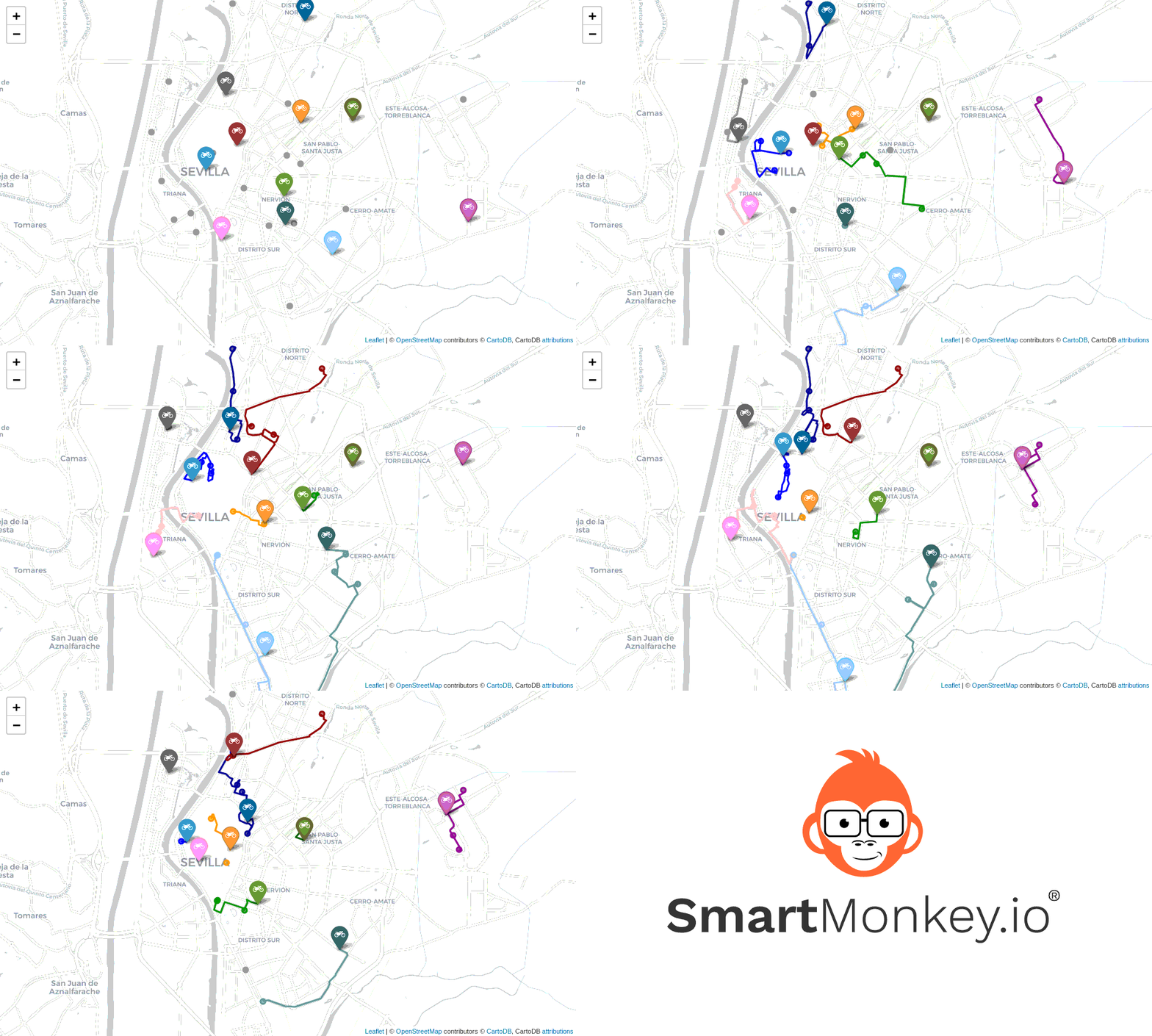
Modeling this scenario can be quite a challenge and that's why SmartMonkey you have been working on this problem for a while. We call our solution Online Programming Optimization Model (OSOM) (Yes, branding isn't one of our strengths 😅, but phonetically it sounds like “incredible” and that's pretty fun). OSOM can model business limitations and find a viable solution to the dispatch problem.
In the simulation below, we have modeled a world where:
- A courier can be assigned several pickups and deliveries at once.
- and the first next service in each message is fixed and cannot be reassigned in subsequent iterations.
The visualization contains twenty iterations of the world divided into Two steps :
1. New incoming services are marked in gray.
2. Services are dynamically assigned to messengers to optimize total delivery time.
Sorry, no blog posts were found for your query.
Move the world smarter


.png)


