
The DeCA is now mandatory: Spain's transport control document is electronic only.
Since 5 October 2026, domestic road freight in Spain runs without paper and inspectors can fine from day one. Here's who is affected, what inspectors ask for and how Routal issues the DeCA for every shipment.
What is the DeCA and since when is it mandatory?
The DeCA is the administrative control document for road freight transport for hire (Order FOM/2861/2012) in electronic format: a PDF with a QR code that inspectors download on the spot. It is mandatory for domestic transport since 5 October 2026 (Law 9/2025 on Sustainable Mobility), with no grace period. It is not the eCMR: that is the consignment note for international transport, and it remains voluntary.
Official sources: Spanish Ministry of Transport (DeCA FAQ) · BOE







The DeCA, explained simply
The administrative control document isn't new: it has existed since Order FOM/2861/2012 and travels with every shipment carried for hire. What changes on 5 October 2026 is the format: paper is no longer valid and the document becomes an electronic file meeting the requirements of the 5 June 2026 Resolution.
What the DeCA is
One PDF per shipment with a QR code. The QR leads to a web address from which inspectors download the document without logging in. It is kept for at least a year and needs no signature.
Who it binds
Road freight transport for hire with origin and destination in Spain, cabotage included. Both the contracting shipper and the performing carrier are liable.
Who is exempt
Own-account transport (you deliver your own goods with your own vehicles and staff), parcel services, house removals and vehicles up to 2 tonnes maximum authorised mass.
From paper to the DeCA: key dates
The control document has existed since 2012. What the timeline sets is the move to electronic.
- December 2012
The administrative control document is born
Order FOM/2861/2012 regulates the document that travels with every shipment carried for hire, on paper.
- December 2025
Law 9/2025 enters into force
The Sustainable Mobility Law sets that the control document goes digital ten months after the law takes effect. That is the whole adaptation period.
- 12 June 2026
The BOE publishes the DeCA technical requirements
The 5 June 2026 Resolution of the Directorate-General for Road and Rail Transport sets the format: a PDF with a QR code and a web address from which inspectors download the document without logging in. The repository can sit on any domain, with no prior notification.
- 5 October 2026
The DeCA is mandatory and paper is no longer valid
The control document for domestic road freight for hire is only valid in electronic format. There is no grace period: the Ministry has confirmed there will be no penalty-free phase.
- 9 July 2027
eFTI Regulation (EU)
EU authorities become obliged to accept transport information electronically. It doesn't change the DeCA, but it shows where the whole sector is heading.
Sources: Spanish Ministry of Transport: DeCA FAQ · BOE: Order FOM/2861/2012, Law 9/2025 on Sustainable Mobility and the 5 June 2026 Resolution · European Commission: Regulation (EU) 2020/1056 (eFTI).
Issue the DeCA from the route and go paperless
Routal generates the control document for every shipment from the data the route already holds, and captures proof of every delivery. One system to plan, deliver, comply and prove.
Digital proof of delivery (ePOD)
Capture photos, digital signature, geolocated timestamps and PIN-secured handoffs. All evidence is attached to the delivery record.
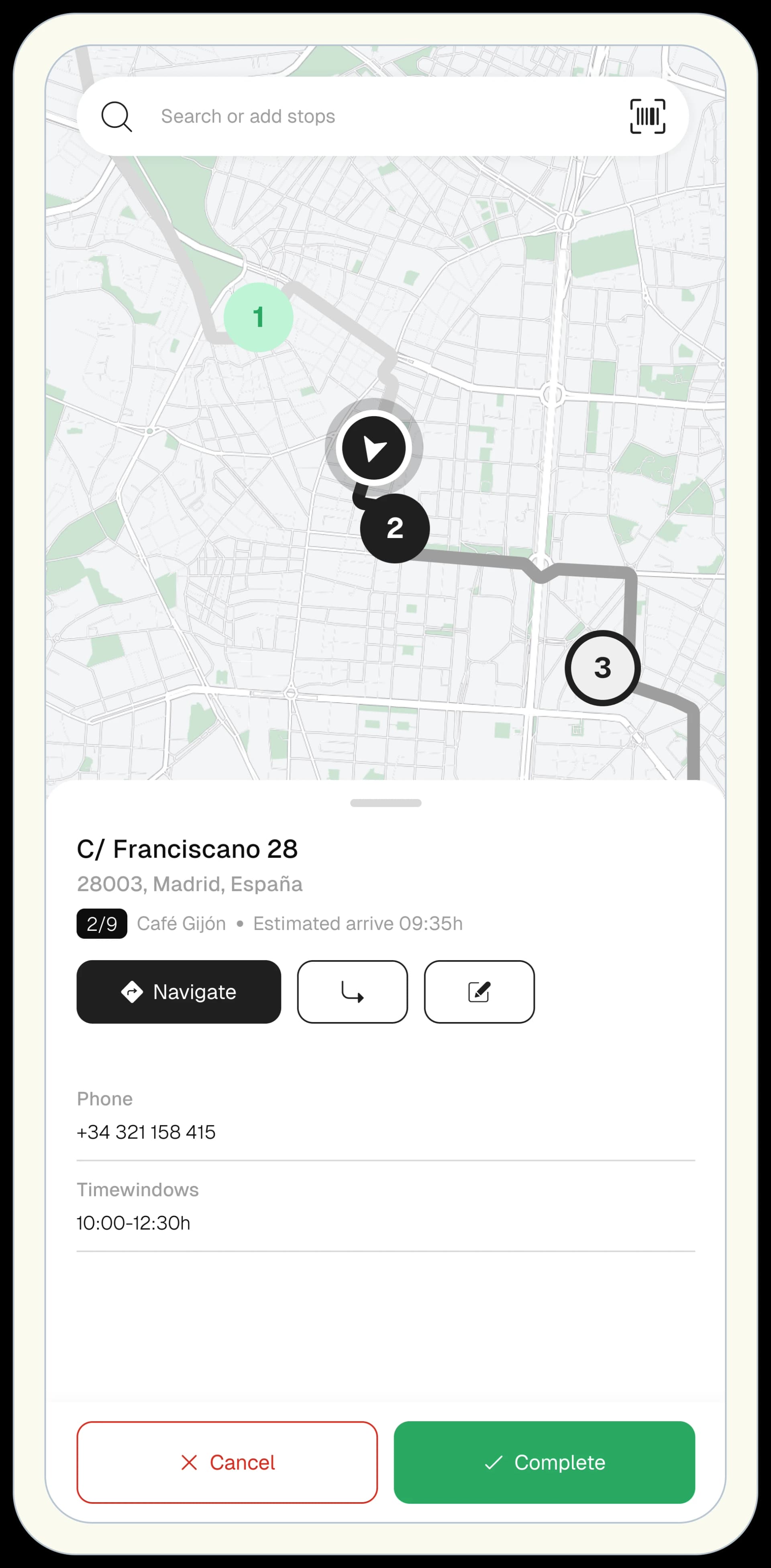
A DeCA for every shipment, no extra steps
When the route is sent to the driver, every shipment leaves with its DeCA: a PDF with a QR code and a direct-download address for inspectors, kept for at least a year.
Real-time visibility
Dispatch and drivers see the same thing: status of every stop, ETAs and incidents, no phone calls needed.
Traceability and fewer disputes
Every milestone is captured with audit-ready evidence, reducing claims and speeding up issue resolution.
The DeCA is built from the shipper, carrier, origin, destination, goods, date and number plate already in the route. It covers deliveries with your own fleet: shipments you subcontract to another carrier are documented by that carrier. What Routal doesn't issue is the eCMR for international transport, which remains voluntary.

Everything about the DeCA
The most common questions about Spain's electronic transport control document.
- Only if you carry goods for hire or reward: other companies' goods, and you charge for the transport. If you deliver your own goods with your own vehicles and staff, that's own-account transport (transporte privado complementario) and you don't need a DeCA. You do need documents on board showing the goods belong to your company or are part of its business. Haulage for hire has exemptions too, such as parcel delivery and vehicles up to 2 tonnes.
Menos incêndios. Mais controle diário.
Se desejar, podemos fazer uma demonstração adaptada à sua operação.